
Anatomy of the runtime#
You can get a long way with tractor by treating it as “trio
with nurseries that spawn processes”. But once you start asking
where does my msg actually go?, which process is that? or
who keeps the phonebook?, it pays to know how the runtime hangs
together. This page walks the stack top to bottom.
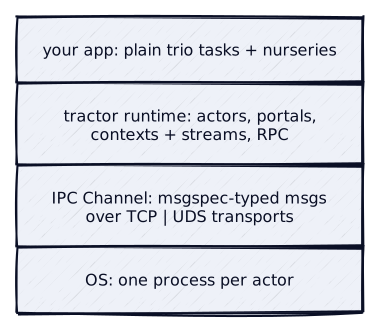
The four runtime layers inside every actor process.#
The layer cake#
Every actor process is the same four-layer sandwich:
your app: plain
triotasks, nurseries and cancel scopes; nothing special.tractoris a structured concurrency (SC) multi-processing runtime built on trio and the whole pitch is that this layer stays just trio: no callbacks, no futures, no proxy objects.the
tractorruntime: a per-processtractor.Actorrunning the msg loop and RPC task scheduler, plus the user-facing primitives layered on it:tractor.ActorNursery(spawning + supervision),tractor.Portal(calling into a peer) andtractor.Context+tractor.MsgStream(SC-linked cross-actor task pairs and streaming).IPC channels: one
tractor.Channelper connected peer, each wrapping aMsgTransportthat ships msgspec-typed msgs over TCP or UDS.the OS: one process per actor, started by a swappable spawn backend.
The property that holds it all together: SC composes through
the layers. A crash in a leaf actor’s app task unwinds that
actor’s trio tree, ships across its IPC channel as a typed
Error msg, and unwinds the parent’s trio tree in turn — the
“SC-transitive supervision protocol” from the README’s pitch.
The whole tree cancels and errors like one big trio program; it
just happens to be spread across processes.
One actor, one process, one trio.run()#
A tractor “actor” is not a green thread, nor an object with
a mailbox, nor a coroutine: it’s one OS process running one
trio.run() whose root task boots the runtime machinery —
msg loop, RPC task scheduler, IPC server — all embodied by a
single tractor.Actor instance.
You rarely construct an Actor yourself; the
runtime makes exactly one per process and you grab it with
tractor.current_actor():
import tractor

actor = tractor.current_actor()  # NoRuntime if none running
print(actor.aid.name)   # str name, need not be unique
print(actor.aid.uuid)   # uuid4 str, IS unique
print(actor.aid.pid)    # the OS pid
print(actor.uid)        # legacy (name, uuid) pair
Identity is carried by the Aid msg-struct (see
tractor.msg.types): a name/uuid/pid triple
exchanged in the very first “mailbox handshake” whenever two
actors connect. It’s what the registrar stores and what shows up
in logs and proc-titles. The older .uid 2-tuple of
(name, uuid) predates Aid and is still pervasive across
the codebase; treat it as the legacy spelling of the same
identity.
If this smells like the actor model, sure — but as the
README warns, it probably doesn’t look like what you think an
actor model looks like, and that’s intentional. Here an “actor”
is purely a runtime-unit-of-abstraction: process +
trio.run() + IPC machinery.
IPC: channels, transports, addresses#
Two connected actors talk through a tractor.Channel: a
duplex, per-peer msg pipe. Each Channel wraps a
MsgTransport instance which does the wire work: framing,
encode/decode and the socket itself. The encoding is msgpack
(via msgspec) and every msg is an instance of one of the
runtime’s tagged-union msgspec.Struct types: the
Aid handshake, Start/StartAck (RPC init),
Started/Yield/Stop/Return (the ctx dialog
phases), Error, etc. There is no raw-bytes mode; the
msg-spec is the protocol, which is exactly what lets payloads
be type-limited per-context (see pld_spec in
The Context: a cross-actor task pair).
Addresses come in two spellings:
unwrapped: the plain-tuple form you pass to user APIs —
('127.0.0.1', 1616)for tcp, or a(<filedir>, <filename>)path-pair for uds;wrapped: the internal
TCPAddress/UDSAddressstruct types (plus libp2p-style multiaddr helpers over intractor.discovery).
You only ever need the tuple form; the runtime wraps and unwraps at the boundaries.
TCP: the boring default#
The default transport ('tcp') binds each actor’s IPC server
to loopback ('127.0.0.1', <random port>) unless told
otherwise, and is the only choice when your tree spans hosts.
Nothing exotic: trio TCP streams + length-prefixed msgpack
framing.
UDS: same-host, creds included#
Pass enable_transports=['uds'] and actors instead talk over
unix-domain sockets, with socket files placed in the per-user
runtime dir: $XDG_RUNTIME_DIR/tractor/ on linux, a short
owner-only /tmp/tractor-<uid> dir on Darwin, and the
platformdirs equivalent elsewhere. Two perks over tcp on a single
host:
no ports to fight over; addrs are just file paths,
the kernel snitches on your peer for free: the listening side reads the connector’s
pid(plusuid/gidon linux) straight off the socket viaSO_PEERCRED/LOCAL_PEERPID— no extra handshake msgs required B)
Warning
Socket-file lifetime == listening actor lifetime. On
listener teardown the runtime os.unlink()s the socket
file immediately, so any late connection attempt (say, a
sub-actor racing to deregister with a registrar that’s
already shutting down) fails with FileNotFoundError.
And ofc, UDS is same-host only.
Here’s a full actor tree run entirely over uds:
'''
Demonstrate an actor tree which talks over unix-domain-socket
(UDS) transport instead of the default TCP: pass
`enable_transports=['uds']` when opening the root and every
subactor inherits the preference.

Every channel address is a filesystem socket path (no TCP port
in sight!) and, as a kernel-provided bonus, the peer's pid is
exchanged for free via `SO_PEERCRED` on linux,
`LOCAL_PEERPID` on macOS.

'''
import os

import trio
import tractor


async def report_addr() -> str:
    '''
    Return this actor's own accept (bind) addr + pid.

    '''
    actor: tractor.Actor = tractor.current_actor()
    addr: tuple[str, int|str] = actor.accept_addr
    pid: int = os.getpid()
    return f'{actor.name}@{addr} pid={pid}'


async def main() -> None:
    '''
    Run a child actor over the UDS transport.

    '''
    an: tractor.ActorNursery
    async with tractor.open_nursery(
        enable_transports=['uds'],
    ) as an:
        portal: tractor.Portal = await an.start_actor(
            'uds_child',
            enable_modules=[__name__],
        )
        # the channel's remote addr is a `UDSAddress`: a
        # filesystem socket path, NOT a (host, port) pair!
        raddr = portal.chan.raddr
        assert raddr.proto_key == 'uds'
        # NOTE, `.sockpath` is the *shared listener* socket file
        # (named for the root registrar) this channel rode in
        # on, NOT a per-child path; the child-specific identity
        # we get for free is the kernel-reported peer pid (via
        # `SO_PEERCRED` on linux, `LOCAL_PEERPID` on macOS).
        print(
            f'portal chan tpt proto: {raddr.proto_key!r}\n'
            f'listener sock file: {raddr.sockpath}\n'
            f'kernel-reported peer pid: {raddr.maybe_pid}\n'
        )
        # ask the child for its OWN distinct bind addr: another
        # socket-file path under the runtime dir.
        child_report: str = await portal.run(report_addr)
        print(f'child says: {child_report}')
        await portal.cancel_actor()


if __name__ == '__main__':
    trio.run(main)
Picking a transport#
Transport choice is per-actor via the enable_transports
kwarg accepted by tractor.open_root_actor() (and proxied
through open_nursery() when it implicitly boots the
runtime), plus per-child via
ActorNursery.start_actor(enable_transports=...). Two rules
the runtime enforces today:
exactly ONE transport per actor: multi-transport actors are on the roadmap but currently raise
RuntimeError;your
registry_addrsprotos must all be inenable_transports: mismatches fail fast withValueErrorinstead of (as in darker times) hanging the registrar handshake forever.
Spawn backends#
How does an actor actually become a process? Via a swappable
spawn backend, selected with the start_method kwarg to
tractor.open_root_actor():
'trio'(default)The home-grown spawner: re-exec the child as
python -m tractor._childusingtrio’s subprocess machinery, then bootstrap it over the first IPC exchange (the parent ships aSpawnSpecmsg carrying all init state). Supported on all platforms and the most battle tested choice by far.'mp_spawn'/'mp_forkserver'The stdlib
multiprocessingstart-methods of the same names (forkserver is posix-only). Mostly interesting for ecosystem compat and start-up-latency tuning.'subint'(in development, py3.14+)On the roadmap (not yet selectable via
start_methodon this release): run each actor as a PEP 734 sub-interpreter (concurrent.interpreters) driven on its own OS thread inside the parent process — interpreter-level shared-nothing isolation with much faster start-up. Yes, this bends the one-actor-one-process rule; the rest of the model is unchanged.
The TRACTOR_SPAWN_METHOD env-var beats any caller-passed
start_method, so you can swap backends under an unmodified
app:
TRACTOR_SPAWN_METHOD=mp_forkserver python my_app.py
One current limitation worth knowing: debug_mode=True (the
crash-to-REPL machinery) is only supported on backends whose
child-side runtime is trio-native, e.g. the default 'trio';
see “Native” multi-process debugging for the deats.
The registrar#
Discovery needs a phonebook. Every actor, as part of boot,
registers its Aid and bind-addrs with the registrar: an
otherwise ordinary actor (a tractor.Registrar, subtype
of Actor) that keeps the name -> addrs table
for the tree; on graceful exit each actor de-registers itself.
Who is the registrar? Decided at root boot, rendezvous style.
tractor.open_root_actor() probes each addr in
registry_addrs with a quick connect-ping, then:
somebody answered: this root is a plain actor; it registers with the existing registrar and binds random same-proto addrs for its own IPC server;
nobody answered: this root becomes the registrar and binds the registry addrs itself.
So single-program trees need zero config — the root quietly
self-appoints — while multi-program setups share a registrar by
pointing every program at the same registry_addrs. Pass
ensure_registry=True to demand that this call create the
registry; it raises if the addrs are already served.
The lookup APIs — tractor.find_actor(),
tractor.wait_for_actor(), tractor.query_actor() and
tractor.get_registry() — all consult it (after first
checking already-connected peers):
'''
Demonstrate the "service daemon" pattern: a named,
long-lived actor spawned via `ActorNursery.start_actor()`
which any other task can locate through the registrar using
`tractor.find_actor()` / `tractor.wait_for_actor()` - no
spawn-portal required - and RPC into directly.

Teardown is explicit and graceful via `portal.cancel_actor()`
once the clients are done.

'''
import trio
import tractor

_quotes: dict[str, float] = {
    'btcusdt': 66_000.5,
    'ethusdt': 3_500.25,
}


async def get_quote(sym: str) -> float:
    '''
    Look up the "current" quote for a symbol.

    '''
    name: str = tractor.current_actor().name
    print(f'{name}: serving quote for {sym!r}')
    return _quotes[sym]


async def client_task() -> None:
    '''
    Locate the quote service by name and RPC it; note no
    spawn-nursery/portal reference is ever passed in here!

    '''
    # a lookup miss yields `None` (not an error).
    maybe_portal: tractor.Portal|None
    async with tractor.find_actor('no_such_svc') as maybe_portal:
        assert maybe_portal is None
        print('client: "no_such_svc" is not registered')
    # block until the service shows up in the registry,
    # then call into it through the delivered portal.
    portal: tractor.Portal
    async with tractor.wait_for_actor('quote_svc') as portal:
        quote: float = await portal.run(
            get_quote,
            sym='btcusdt',
        )
        print(f'client: got btcusdt quote {quote}')


async def main() -> None:
    '''
    Run a discoverable quote service and its client.

    '''
    an: tractor.ActorNursery
    async with tractor.open_nursery() as an:
        portal: tractor.Portal = await an.start_actor(
            'quote_svc',
            enable_modules=[__name__],
        )
        # run the client in a separate task which discovers
        # the daemon purely by its registered name.
        tn: trio.Nursery
        async with trio.open_nursery() as tn:
            tn.start_soon(client_task)
        # explicit graceful teardown of the daemon.
        print('root: cancelling quote_svc')
        await portal.cancel_actor()
    print('root: service shut down cleanly')


if __name__ == '__main__':
    trio.run(main)
If you bump into “arbiter” in old issues or posts: that’s the
legacy name for the same thing, surviving in-code only as the
Arbiter = Registrar class alias; all current terminology is
“registrar”/”registry”. Fair warning per the README: this is
still a very naive discovery sys (no re-election, no gossip
protocol… yet) and a registrar is expected to outlive its
registrants.
Runtime env vars#
A few env-vars let you re-tune a whole tree without touching app code; each wins over its corresponding kwarg:
env-var |
effect |
vs. kwarg |
|---|---|---|
|
crank (or silence) console-log verbosity for every actor in the tree |
beats |
|
swap the process spawn backend |
beats |
|
install the |
OR’d with |
Spotting actors from your shell#
Every sub-actor sets an OS-level proc-title of the form
_subactor[<name>@<pid>] (via setproctitle, silently
skipped when not installed) so ps/htop/pstree show
which actor is which at a glance. The README’s signature
incantation — watch a tree build and self-destruct live:
$TERM -e watch -n 0.1 "pstree -a $$" \
    & python examples/nested_actor_tree.py \
    && kill $!
For scripting there are two stable cmdline markers:
pgrep -fa '_subactor\['     # live, titled sub-actors
pgrep -fa 'tractor._child'  # 'trio'-backend children not
                            # yet (re)titled
The title also lands in the kernel comm (truncated to ~15
bytes) which survives into zombie state — that’s what
tractor’s own test-harness reapers key off. To be crystal
clear about the contract though: you should never need a
reaper; if you can create zombie child processes (without using
a system signal) it is a bug — please report it!
Logging#
The runtime logs through a thin adapter over stdlib
logging that stamps every record with actor + task info.
Two calls get you going:
from tractor.log import get_console_log, get_logger

log = get_logger(__name__)  # actor/task-aware sub-logger
get_console_log('info')     # attach console handler @ level
(or just pass loglevel='info' to
tractor.open_root_actor() and the console handler comes up
with the runtime).
tractor adds custom levels — and matching logger methods —
that slot between the stdlib ones so you can dial in which
runtime subsystem you want to hear from: .transport() (5),
.runtime() (15), .devx() (17), .cancel() (22), plus
a PDB (500) level for debugger chatter. E.g.
loglevel='cancel' plays the whole cancellation chorus while
staying quiet about transport-layer noise. Beyond that
tractor isn’t opinionated about how you consume logs: it’s
all stdlib logging underneath.
Where to next?#
See also
The Context: a cross-actor task pair — the SC-linked cross-actor task API that rides on every
Channel.“Native” multi-process debugging —
debug_mode, the multi-process REPL andstackscopetask-tree dumps.Structured concurrency, across processes — why one-actor-one-process, and what kind of “actor model” this is (and isn’t).